Google's Ask Advisor is free. The audit trail isn't.
6 min read
TL;DR: Ask Advisor, Google’s Gemini-powered agent across Ads, Analytics, and Merchant Center, can set up campaigns, not just suggest them. Whether to adopt it is not a capability question, it is a governance one. Evaluate the audit trail against four questions - who acted, what changed, why, and how to roll back - and hold the agent at act-with-approval until all four have answers.
In May, Google introduced Ask Advisor: a Gemini-powered agent that spans Google Ads, Google Analytics, and soon Merchant Center. It does not stop at insights. Ask it to “find new customers for my hair care products” and, in Google’s own words, it will “automatically pull product details from Merchant Center to set up your new campaign.” It is in beta for English-language accounts, with more rolling out through the year.
Every ad platform demo this summer looks like this: an agent that reads your accounts, recommends, and increasingly acts. The commentary splits into two camps - “this will save teams hours” and “this will spend your budget on Google’s priorities.” Both are true and neither is the decision. I manage performance budgets for a living, and the question I actually have to answer this quarter is not is the agent good. It is what happens on the Tuesday it does something wrong, and can I prove what happened.
That makes the audit trail the product. Everything else is a feature.
The industry said the quiet part
Digiday’s reporting on the launch carried the line that names this era: “The more autonomous these systems become, the more trust becomes the product,” from agency founder John Geletka. The same piece has agency leads asking for manual kill switches and noting the reporting gaps - Katya Constantine of DigiShopGirl Media points out there is still no breakout report on AI inventory. Meanwhile AI-driven advertising is projected to reach $57 billion, around 12 percent of the US ad market, and of the thirteen agency executives Digiday interviewed, not one had pulled budgets over transparency concerns.
Hold those two facts together: everyone has governance concerns, and nobody is walking away. That is not hypocrisy, it is the honest shape of the situation. The performance upside is real, the platform asymmetry is real, and opting out is not a strategy. Which means the real work is deciding, precisely, how much authority to delegate and what evidence you require in exchange.
My favorite piece of evidence that this question is unsolved is a year old. When Google previewed its earlier ads agent, a Google director was asked how agent-made changes would show up in change history. The answer, verbatim: “I don’t know if it’ll show up with your username or like you and the agent’s username.” A year later, with a more powerful agent in beta, that remains the sharpest due-diligence question you can ask, and you should ask it before granting anything write access.
The question is not whether the agent is good. It is what happens on the Tuesday it does something wrong, and whether you can prove what happened.
The ladder, and where to stand on it
Agent authority is not a yes/no. It is a ladder, and each rung is effectively a different product with a different risk profile.
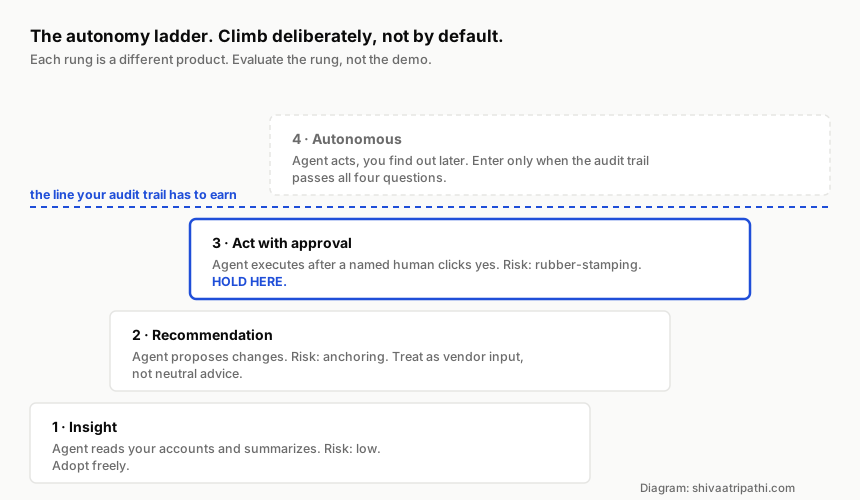
Rung 1, insight, is safe and genuinely useful. An agent that reads across Ads and Analytics and summarizes what a human would have found in an hour is a gift to a lean team. Adopt it.
Rung 2, recommendation, needs one mental adjustment: a recommendation from the seller of the inventory is vendor input, not neutral advice. Ad platforms have recommended more broad match and more automation for a decade, through interfaces that looked like objective scores. An agent phrases the same incentives more persuasively. Read its suggestions the way you read a media kit.
Rung 3, act with approval, is where I would operate Ask Advisor today, with a rule: the person clicking yes must be able to restate what will change in one sentence. If approval means “the agent showed me a paragraph and I clicked accept,” you are on rung 4 with extra steps. Rubber-stamping is autonomy wearing a compliance costume.
Rung 4, autonomous, is not forbidden. It is earned - by the audit trail, per the four questions below, and probably first in low-stakes corners: budget-capped experiments, non-brand campaigns, markets where you can afford a bad week quietly.
The four questions
Before any agent - Google’s, or the ChatGPT and LinkedIn equivalents that will follow - gets write access to accounts I am responsible for, the change history has to answer four questions. Run this against a real change entry in the beta, not against the sales narrative.
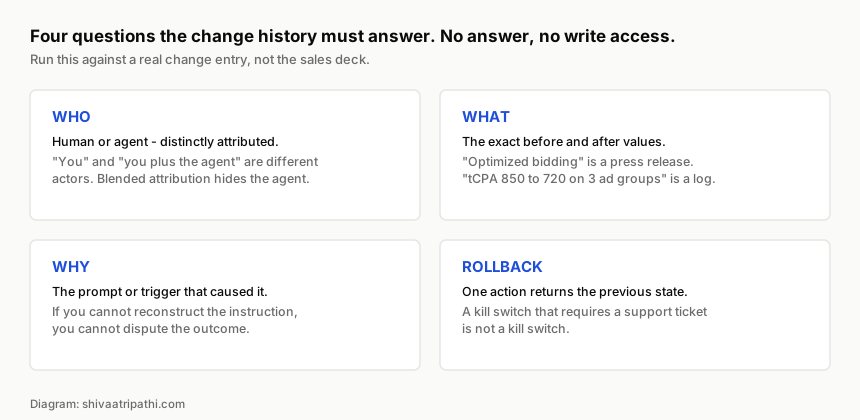
Who. Human and agent must be distinctly attributed - the exact thing Google could not answer a year ago. If changes land under a blended identity, then three months from now, when the CFO asks why spend shifted, “me or the robot, unclear” is your answer of record.
What. Exact before and after values. “Optimized bid strategy” is a press release; “tCPA 850 to 720 on three ad groups, campaign X” is a log entry. You are looking for the latter.
Why. The prompt, recommendation, or trigger that produced the change, preserved. If you cannot reconstruct the instruction, you cannot dispute the outcome, learn from it, or explain it to anyone.
Rollback. One action that restores the previous state, available to you, not to a support queue. The Digiday sources asking for a “manual kill switch” are asking for exactly this, and its absence is disqualifying for rung 4.
This is thirty minutes of work in the beta: make the agent do something small, then open change history and grade the entry. The result is your adoption policy, written for you.
Do this before the quarter ends
Three concrete moves. First, run the four-question test and file the result where your team plans; the tooling will change fast, and you want a dated record of what the audit trail could and could not answer. Second, set your rung explicitly - write “we operate AI ad agents at act-with-approval; here is who approves” into your ops doc, because an undecided policy is rung 4 by drift. Third, put a recurring quarterly review on the calendar: re-run the test, re-decide the rung. Platforms in an arms race ship faster than annual planning cycles.
The teams that get hurt by agentic ad tools will not be the ones that adopted them or the ones that refused. They will be the ones that never decided, and found out which rung they were standing on from an invoice.
The buyer’s side of this same shift is agents doing the shortlisting before humans arrive. The seller’s side is agents spending your budget. Both sides reward the same discipline: decide what the machine may do before the machine decides for you.