Instrument AI referral traffic yourself before you pay for an AEO tool
5 min read
TL;DR: The AEO tool category just minted a unicorn, and most teams evaluating those dashboards have never segmented an AI referrer in GA4. Build the free four-layer stack first - referrer regex, channel group and behavior, crawler logs, the Search Console gen-AI report - run it for 60-90 days, then pay only for the one thing it cannot see: competitor share-of-voice inside the engines.
In February, Profound raised a $96 million Series C at a $1 billion valuation to help brands stay visible in AI search - $155 million raised in under two years, against a crowded field of funded competitors. AI visibility is the hottest line item in the 2026 martech budget, and the pitch works because the fear is legitimate: buyers really are asking assistants instead of clicking results.
Here is what I keep seeing, though, from inside the budget conversations: teams shortlisting four-figure-a-month dashboards who cannot yet answer “how many sessions did ChatGPT send us last month?” That number is free. It is sitting in the GA4 property they already have, unsegmented. Buying a share-of-voice dashboard before you have baseline instrumentation is buying a speedometer for a car you have never weighed.
I run AI-search visibility in my day job and I instrumented this site by hand. This essay is the free layer, in buildable order, and the honest decision rule for when a paid tool earns its slot.
Why this month and not eventually
Because the platform mix is moving fast enough that flying blind has a real cost. Goodie’s AI search traffic report, built on an anonymized GA4 panel of B2B brands, tracked ChatGPT’s share of measurable B2B AI referrals falling from 89.1 percent in mid-2025 to 62.6 percent by March-April 2026, with Claude at 18.5, Gemini at 10.6, Perplexity at 7.3, and Copilot at 4.0.
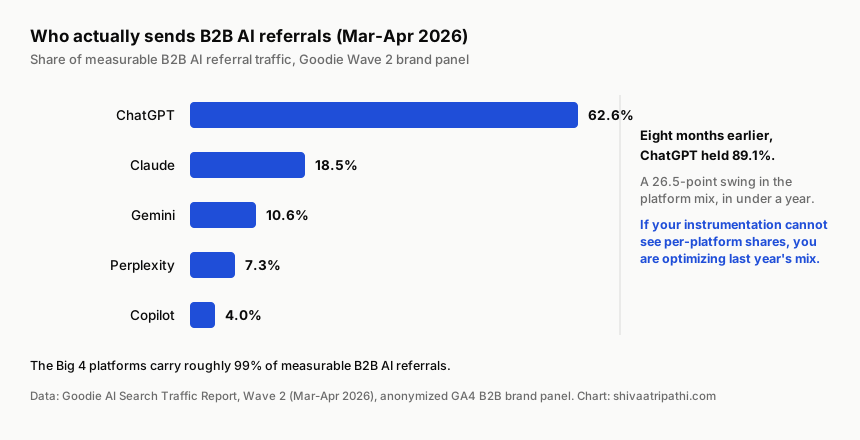
A 26.5-point share swing in eight months means any content or optimization decision keyed to “AI traffic” as one blob is already stale. If Gemini is quietly becoming your second engine because your buyers live in Google Workspace, that changes what you optimize and where. You cannot see any of this without per-platform segmentation, and per-platform segmentation costs nothing.
The same panel found AI-referred visitors averaging about 58.5 seconds of engagement against 44.2 for Google organic - the arriving traffic is warmer, which raises the price of not measuring it.
The four-layer stack
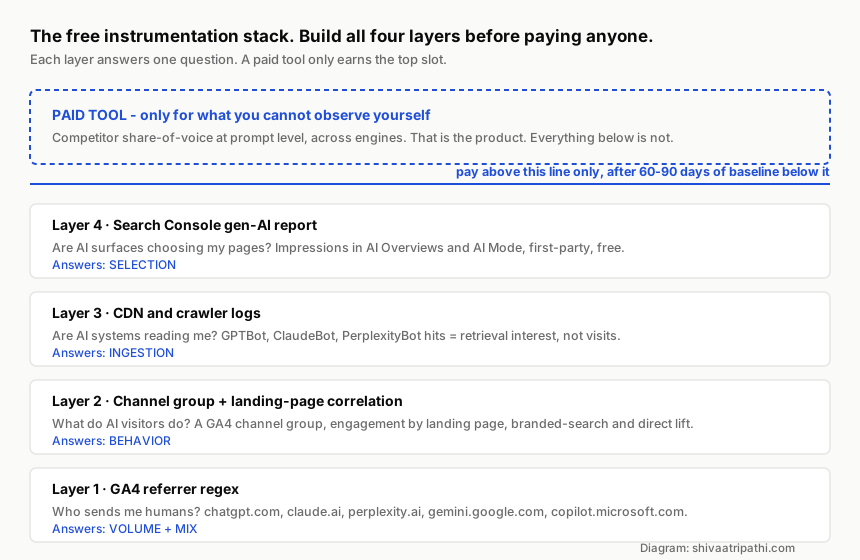
Layer 1: the referrer regex - who sends me humans. In GA4, segment sessions where the referrer matches the assistant domains. A starting regex:
chatgpt\.com|chat\.openai\.com|claude\.ai|perplexity\.ai|gemini\.google\.com|copilot\.microsoft\.comTwo honest caveats. Referrer strings change as platforms rename and re-architect (the panel data above exists precisely because someone maintained this list), so review it monthly. And some assistant click-outs arrive with no referrer at all, landing in direct - your regex captures a floor, not a total. The floor is still infinitely more useful than the blob.
Layer 2: the channel group and behavior - what AI visitors do. Promote the regex into a GA4 custom channel group (“AI Referrals”) so every standard report can split by it without ad-hoc segments. Then watch two things: engagement by landing page (which pages do assistants send people to, and do those people stay?), and your branded-search plus direct trend next to AI-referral volume. That second pairing matters because of the no-referrer leak: if AI referrals and unexplained direct rise together, the leak is visible even though no single session is attributable. This is the “expects machines” attribution posture, on the cheap.
Layer 3: crawler logs - are AI systems reading me at all. Referrals are the end of the funnel; ingestion is the start. Your CDN logs show GPTBot, ClaudeBot, PerplexityBot, and Google-Extended hits: which pages get fetched, how often, and whether your robots.txt or CDN is quietly blocking the crawlers your buyers ask for recommendations. I have watched an edge setting silently override a clean robots.txt on this very site; check what is served, not what is committed. Crawler hits are not visits and never will be - they are leading indicators that your content is in the retrieval pool.
Layer 4: the Search Console gen-AI report - are AI surfaces choosing me. As of June, Google reports your impressions inside AI Overviews and AI Mode, first-party and free. It has no click data, which makes it useless as a KPI and excellent as a selection signal - I wrote a full workflow for joining it against the classic Performance report to produce a rewrite queue. In this stack, it is the fourth question answered: volume, behavior, ingestion, selection.
Total build cost: an afternoon, maybe two if channel groups are new to you. Run it for 60 to 90 days before any vendor call, because every conversation changes when you can say “ChatGPT sends us 3x Perplexity, but Perplexity visitors read the pricing page.”
Buying a share-of-voice dashboard before you have baseline instrumentation is buying a speedometer for a car you have never weighed.
What a paid tool is actually for
After the stack is running, exactly one gap remains, and it is real: you cannot see your competitors, and you cannot see inside the engines. Your GA4 knows what AI platforms send you; it cannot know how often ChatGPT recommends your competitor instead, for which prompts, in which markets. That - prompt-level share-of-voice across engines - is the legitimate product, and the reason the category deserves to exist.
So the decision rule: a paid AEO tool is justified when (a) your own stack shows AI referrals are material or fast-growing for you, (b) you have named competitors you need benchmarked, and (c) you will act on prompt-level gaps with content or positioning work. If any of the three is false, the dashboard is a screenshot generator.
And one caveat to carry into the demo: every tool in the category samples. They run synthetic prompt panels against the engines, and synthetic prompts are somebody’s guess at what your buyers ask. The tool can tell you that you lose “best CPaaS for Indian enterprises” and be blind to the phrasing your actual buyers use. Ask every vendor how their prompt set is built, how often it refreshes, and whether you can seed it with real queries from your sales calls. The quality of that answer is the quality of the product.
The pattern here is the same one I keep writing about: when a category is selling hard, interrogate the numbers first. The vendors are not wrong that AI visibility matters. They are just hoping you skip the part where most of it is measurable for free.