Your marketing team needs a shared AI brain, not five personal ones
7 min read
TL;DR: The AI-brain trend is designed for individuals, and copying it as a team wastes the compounding it promises. Five personal context systems drift apart and relearn the same facts five times. Build one shared, versioned brain instead: eight files, one owner each, read by every agent on every task. It takes a week; the template is below.
The personal AI brain is the genre of the summer. Andrej Karpathy’s LLM Wiki idea went viral in April: let the model build and maintain a persistent, structured knowledge base instead of rediscovering everything on every query. Brian Halligan built an agent trained on his entire working life. Kieran Flanagan mapped the whole movement in July: systems that “think, remember, and act” on your behalf, an army of operators building their own.
I believe in the pattern. I run a version of it. And I think the way most marketing teams are about to adopt it is subtly wrong, because every reference implementation in that genre is built for one person, and a team that copies it gets five brains where it needed one.
The relearning tax
Watch what actually happens when a five-person demand gen team goes AI-first without a plan. Each person sets up their own assistant, their own custom instructions, their own pasted context. Each of those setups needs to know the same things: who the ICP is, what the positioning is, what the voice rules are, which channels run in which market, what was tested last year and why it was killed.
So the same context gets written five times, by five people, from five memories, at five levels of staleness. Priya’s setup has the ICP from two quarters ago. Arjun never encoded the voice rules, so his drafts come back sounding like a press release. The new hire has nothing and starts from zero. Nobody’s setup knows the webinar experiment was killed for cost per opportunity, so two of them will propose it again by December.
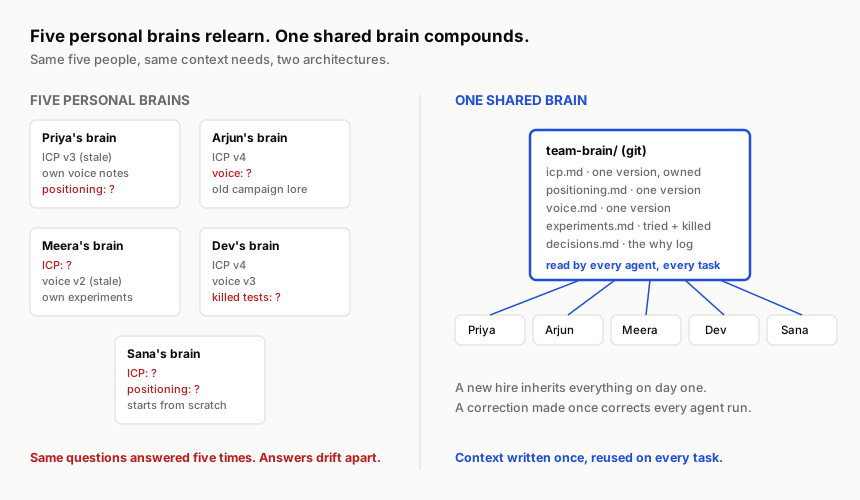
The compounding that makes a personal brain valuable - Flanagan’s whole argument - comes from the same context being reused and refined across many tasks. A team fragments that compounding five ways and then wonders why AI output quality varies so much by person. It is not a prompt-skill gap. It is a context gap, and it is structural.
Why this is not the wiki dying again
The obvious objection: we tried shared knowledge bases, they were called wikis, and they rotted. Every marketer has watched a Confluence space decay into archaeology.
Wikis rotted because nothing complained when they went stale. The only reader was an occasional human, usually the new hire, usually too polite to flag that the messaging page was three pivots old. Staleness had no cost until someone acted on it, months later, untraceably.
A team brain has a reader with no politeness at all: the model, on every single task. When the ICP file is stale, tomorrow’s draft targets the wrong buyer, visibly, and the fix is one commit. The feedback loop that wikis never had is built into the consumption pattern. Your agents are the linter for your team’s knowledge.
Wikis rotted because nothing complained. A team brain is read by the model on every task, so a stale line becomes a visibly wrong draft within days.
There is also better engineering guidance now than the wiki era ever had. Anthropic’s context engineering write-up makes the point that matters here: do not dump everything into one central file; keep a tree of small, focused files that get loaded at the right time. That is a design principle for a team brain, not just for a coding agent. Curated and small beats comprehensive and dead.
The eight files
Here is the starter structure I would give a five-person B2B team. Not a platform, not a vector database, not a knowledge-management initiative. A git repo with eight markdown files, each with a named owner and a review cadence.
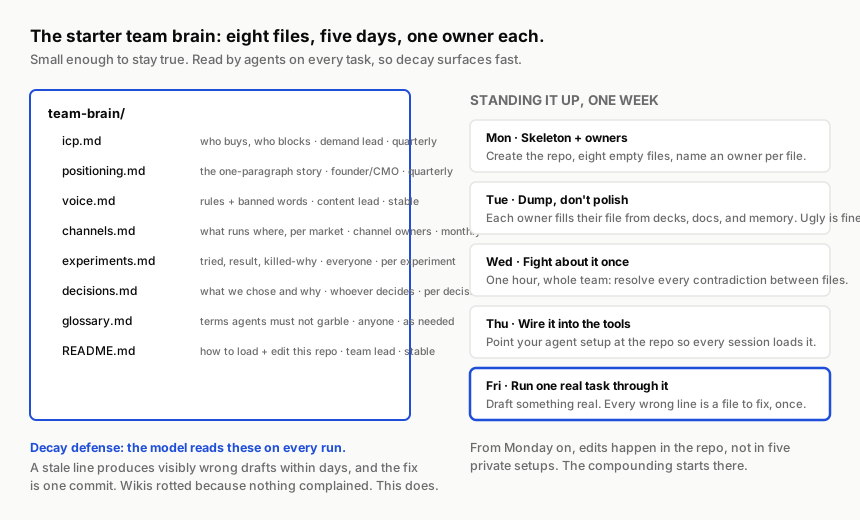
Two of these files do work that personal brains structurally cannot.
experiments.md is the tried-and-killed log: what ran, what it cost, what it produced, why it died. This is the single most valuable file a team can keep, because the most expensive form of relearning is re-running a dead experiment with fresh enthusiasm. No individual’s personal brain accumulates this across the whole team. The shared one does, automatically, if killing an experiment requires writing the line.
decisions.md is the why log: we chose lead-gen forms over landing pages in GCC because X, we stopped bidding on competitor terms because Y. Agents are excellent at relitigating settled questions when they cannot see the settlement. Write decisions down once and every future session starts from them instead of reopening them.
The boundary question - what stays personal - has a clean test: anything two teammates would otherwise have to re-explain to each other belongs in the team brain. Taste, working style, half-formed drafts, personal prompt tricks stay personal. The ICP does not belong to anyone’s personal setup, any more than the CRM does.
One task, end to end
Here is what the brain changes in practice. I published the whole thing as a working template: github.com/shalintripathi/team-brain-template - eight files, each pre-filled with structure and worked example entries for Meridian Analytics, a fictional B2B SaaS company. The walkthrough below uses those exact files, so you can clone the repo and reproduce it.
The task: a teammate asks their agent to “plan a Q4 demand push for mid-market product teams.”
Without the brain, the agent produces the median plan every marketer has seen: a webinar series, some competitor-term bidding, a generic whitepaper. Plausible, confident, and wrong in ways only the team’s history knows.
With the brain loaded, four files intervene before a human touches the draft. icp.md narrows the audience to the VP Product buyer and flags the data-engineering blocker, so the plan targets the build-vs-buy objection instead of generic awareness. experiments.md kills the webinar idea on contact: the fictional team ran that series, got 220 registrants a month and four opportunities in two quarters, and wrote down why it died. Same file, next line, kills competitor-term bidding: 70 percent demo no-show rate, wrong-intent clicks. decisions.md steers the ad format to lead-gen forms, which won a six-week test. And voice.md strips the buzzword hook the model would otherwise reach for, because the banned-word list is a file, not a preference.
What comes back is a plan built on the two things that actually scaled: founder POV posts and the gated benchmark report. Not because the model got smarter, but because it finally knew what the team knows. That is the entire trick. The re-proposed webinar - the one two teammates would have pitched again by December - never makes it to the meeting.
A week, not a quarter
The failure mode to avoid is turning this into an initiative. It is five days of unglamorous work: skeleton and owners on Monday, everyone dumps their version of the truth on Tuesday, one hour of resolving contradictions on Wednesday - this is the day that actually matters, because the contradictions between five people’s context are exactly the drift the team has been shipping into market - wiring on Thursday, and one real task pushed through it on Friday. Every wrong line in Friday’s output is a file to fix, once.
I can offer this site as the experience report. Everything published here runs through a shared brain of exactly this shape: a versioned repo holding the voice rules, the redaction rules, a named source list, a decision log, and a topic pipeline with a tried-and-killed trail. I wrote about what separates a skill from a prompt after shipping 59 agents; the honest sequel is that the agents were never the hard part. The files they read are the product. When a post comes out wrong, the fix is almost never a better prompt. It is a correction to one file, and every future post inherits it.
That is the offer a team brain makes: stop paying the relearning tax, and let corrections compound instead of evaporating into five private setups. The personal AI brain is a genuinely good idea. Your team just should not build five of them.
The takeaway: clone team-brain-template, make it private, and run the five days. The repo has all eight files with owners, review cadences, the Meridian example entries to overwrite, and wiring instructions for Claude and ChatGPT. If your Wednesday contradiction fight surfaces something interesting, I would genuinely like to hear about it - the reply address works.