The mom-and-pop SaaS thesis breaks the moment procurement gets involved
10 min read
TL;DR: Verna’s mom-and-pop SaaS thesis holds where software is bought with a card and stops at the first security questionnaire. The barrier AI collapsed was building. The barrier that decides regulated B2B deals is procurement: audit windows measured in months and data rules written by central banks. Three questions tell you which side your category is on.
You are on the second call with a buyer who likes your product. The call ends well. Forty minutes later an email arrives from someone you have never spoken to, with a spreadsheet attached: the vendor security questionnaire. If you have sold software to a bank, a telco, or a government-adjacent enterprise in India or the Gulf, you know the feeling in your stomach when you open it. If you are a domain expert who just built a brilliant tool with an AI coding agent and are wondering why your first enterprise prospect went quiet, that spreadsheet is a large part of why. This essay is about what it represents, where that barrier actually stands, and where it does not.
Elena Verna published the sharpest version of a thesis I keep meeting in planning conversations: the mom-and-pop SaaS era has arrived. AI has collapsed the cost of building software, so the people who deeply understand a problem, teachers, agents, accountants, consultants, can now build and sell the solution themselves. “The future of software,” she writes, “will be defined by everyone else.” I think she is right, and I think the thesis has a boundary that matters enormously for anyone doing B2B marketing strategy right now. I want to draw that boundary with the actual documents that enforce it, because I sell software from inside it.
Where the thesis holds
Be fair to the argument first. For two decades, the ideas that became products were filtered by development cost: “only ideas large enough to justify those costs ever made it into the world,” as Verna puts it. That filter is gone. A retired claims adjuster can ship the niche insurance workflow tool that no venture-backed team would have prioritized. Prosumer tools, small-business utilities, vertical workflow apps bought by one person with one card: that whole landscape is about to get crowded with software built by people who lived the problem.
If you market a product in one of those categories, the strategic implication is real and uncomfortable. Your future competitors will not look like companies, will not price like companies, and will out-credibility you with the exact audience you serve, because they are the audience. Speed of shipping stops being a moat. Distribution and depth of trust become the whole game.
What the wall is made of
Now walk the same solo builder into my world. I run marketing for a CPaaS and CCaaS company. Our product touches call recordings, customer identity data, and telecom infrastructure across India, Southeast Asia, and the Gulf. Here is what stands between any vendor and a signed contract in this category, as a sequence, because the order is the point.
Step one, the questionnaire. It arrives before anyone has agreed you are the preferred vendor. In my experience of these deals it runs to a few hundred questions, covering encryption at rest and in transit, access control, incident response, sub-processors, business continuity. Answering it is not the hard part. Evidencing it is.
Step two, the audit. The evidence buyers ask for first is a SOC 2 report, the AICPA’s attestation framework for service organizations. Compliance platform Drata, which sells the tooling to get one, describes the enterprise reality plainly: “large organizations rarely consider providers without it.” The same guide gives the mechanism that matters for a solo builder. A Type 1 report assesses control design at a point in time; a Type 2 report, the one enterprise security teams actually want, “assesses operating effectiveness over 6 to 12 months.” Drata’s own published price range for a Type 2 audit runs from $12,000 to $100,000, before the engineering work the controls require. Put the window and the price side by side and the problem for a new entrant is plain. Even with unlimited money, the earliest a new vendor can hold a Type 2 report is six months after its controls are already running, because the observation window is calendar time, not effort.
Step three, data residency, per market. This is the part most of the AI-builds-everything discourse has never encountered, because it is written by regulators, not by product people, and it differs by country. Four rules, with dates.
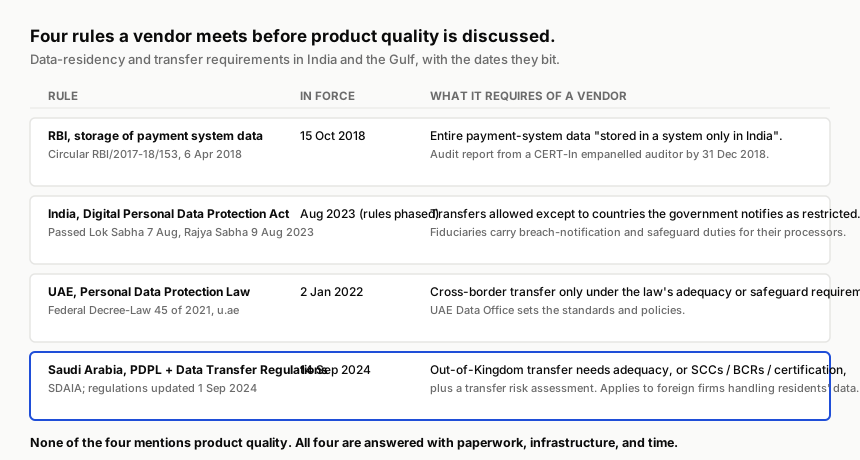
The Reserve Bank of India’s circular of 6 April 2018 (RBI/2017-18/153) requires that “the entire data relating to payment systems” be “stored in a system only in India,” with compliance due by 15 October 2018 and an audit report from a CERT-In empanelled auditor by the end of that year. India’s Digital Personal Data Protection Act, passed by both houses in August 2023, takes a different shape: transfers are permitted except to countries the central government notifies as restricted, and the data fiduciary carries the safeguard and breach-notification duties for its processors. The UAE’s Personal Data Protection Law has been in force since 2 January 2022 and sets the requirements for any cross-border transfer. Saudi Arabia’s PDPL became enforceable on 14 September 2024 under SDAIA, and its updated transfer regulations allow data out of the Kingdom only under an adequacy decision or one of three safeguards, standard contractual clauses, binding corporate rules, or certification, with a transfer risk assessment on top. It applies to foreign organizations handling Saudi residents’ data, so it applies to a vendor selling in from Bangalore or Berlin just as much as to a local one.
Step four, the paper. The data processing agreement, the sub-processor list, the uptime commitment with penalties, the right-to-audit clause. Step five, the committee. Legal, procurement, IT security, and finance all touch the deal before signature, and the cycle is measured in quarters.
Even with unlimited money, the earliest a new vendor can hold a SOC 2 Type 2 report is six months after its controls are already running, because the observation window is measured in calendar months, not in effort.
A worked example
Take the solo builder with the best call-analytics tool in the market and walk them into a Saudi bank’s evaluation. Day one, the questionnaire. Week two, the security team asks for the Type 2 report. There is none, so the clock starts: controls have to be designed and running, then observed for at least six months, then audited. Meanwhile the bank’s data cannot leave the Kingdom without a SDAIA-recognised safeguard and a risk assessment, so the builder needs in-Kingdom infrastructure or a certified transfer mechanism, and a legal entity to sign the DPA. Call it two to three quarters of work before the vendor is even eligible, during which the bank’s buying cycle has run its course and the incumbent, who already holds every one of these documents, has renewed.
None of these steps evaluated the product. They answered one question: can we defend choosing this vendor if something goes wrong? A solo domain expert with a brilliant product has no answer, because the answer is an organizational capability, a compliance function with people, audits and contracts behind it. AI made the code cheap; it did not make any of that cheap.
This is why incumbents in regulated categories keep winning despite slower product velocity, which frustrates every fast-moving competitor and every buyer’s champion. What protects them is the paperwork, and I do not mean that cynically; the paperwork encodes real risk that real buyers carry personally, and it takes time to accumulate. But it means the mom-and-pop wave will wash over some categories and break against others, and marketers need to know which shore they stand on.
The three-question exposure test
When someone on my team, or an investor, or a nervous leadership meeting asks “will AI-built software eat this category,” I now run three questions about the category, not the product.
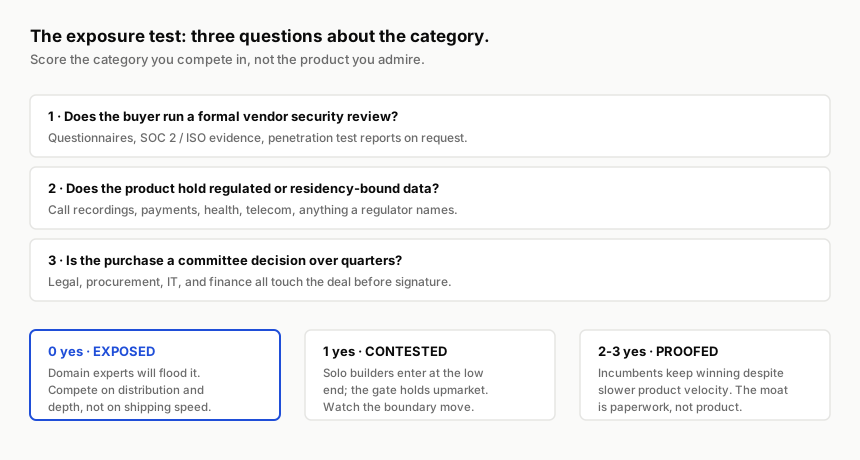
Zero yes answers: exposed. Expect a flood of authentic, cheap, credible competition from people who lived the problem. Marketing implication: stop selling features, because a domain expert’s product will match them; sell distribution, depth, and the accumulated proof a solo builder cannot fake yet.
One yes: contested. Solo builders take the low end, where buyers self-serve and nobody asks for an audit. The gate holds upmarket. Watch the boundary, because compliance tooling keeps making the wall cheaper to climb, and the same Drata guide notes smaller companies increasingly ask for SOC 2 during vendor selection. That cuts both ways: more buyers gating, and more sellers equipped to pass the gate.
Two or three: procurement-proofed. Your competitive set will stay recognisable for years, at least in my experience of these markets. The competitor to watch is not the solo builder but the well-funded company that treats compliance as a product feature from day one.
One wrinkle that is already changing the wall’s shape: it is starting to be read by machines. I wrote about agents becoming the first evaluators of vendors, and pricing researchers at Ibbaka predict buyer agents will screen vendors in or out before a human ever visits the website. Trust pages, security documentation, and audit evidence are becoming machine-readable surfaces. That does not lower the wall for solo builders. It does mean the incumbents hiding their compliance story in a sales deck are wasting their best moat, which is a very fixable marketing failure.
What I do not know
Three things, stated plainly, because the argument has edges.
I do not know how fast compliance automation lowers the wall for very small companies. Vendors in that market publish survey numbers about buyers demanding proof of compliance, and I have not found one whose methodology I could read, so none appear here. If a five-person company can hold a Type 2 report inside a year for a five-figure sum, the “contested” band in the test above widens every year, and the boundary moves toward Verna.
I do not know how much of the Indian mid-market actually enforces the gate. The RBI rule binds payment-system operators; the DPDP Act’s restricted-country list is a power the government holds rather than a list it has used, as far as the public record I checked shows. A mid-market Indian buyer outside payments may ask for the questionnaire and never read the answers. My experience is weighted toward enterprises and regulated buyers, and I should say so.
I do not know whether SDAIA’s adequacy decisions will make Gulf transfers routine. The regulations allow the authority to publish them directly; if a long adequacy list appears, the Saudi row in the table above gets much shorter for vendors hosted in listed countries.
What to watch from here
Four things that would confirm or weaken this argument, each checkable.
- SDAIA’s adequacy list. The authority can now publish adequacy decisions on its own site. A list that includes major cloud jurisdictions lowers the Gulf wall for everyone; an empty list keeps it high.
- The first restricted-country notification under India’s DPDP Act. The transfer power exists on paper. The day it is used, “allowed unless restricted” becomes a live constraint and the India row changes character.
- Type 2 pricing for sub-ten-person companies. Drata’s published range starts at $12,000. If the low end keeps falling and the observation window stays at six months, time becomes the only real wall, and time can be planned for.
- The first solo-built product with a regulated enterprise logo. This is the test case. When a domain expert’s AI-built tool lands a bank or a telco without a compliance function behind it, the thesis has crossed the wall, and I will write that essay too.
Verna’s thesis is a genuinely useful planning instrument once you add the boundary. Run the three questions on your category and act on the verdict. Exposed: your roadmap slide about shipping velocity is comfort food; move the budget toward community, proof, and distribution before the flood arrives. Proofed: your compliance story is a demand-generation asset, not a legal formality. Publish it, structure it, and make sure a buyer’s agent can read it, because defensibility is exactly what the next thousand AI-assisted evaluations will be checking for.