The modern ABM engine breaks the moment you leave the US
6 min read
TL;DR: The modern ABM engine is excellent and quietly American. Its seven steps assume dense, English, provider-indexed data at every stage. Outside the US, enrichment match rates collapse, org charts go opaque, and third-party intent goes silent. The fix is not more data vendors. It is designing the first-party, registry, and field signals your accounts will actually emit.
Kyle Poyar’s guide to building a modern ABM engine is the best operational writeup of account-based marketing I have read. HubSpot as the system of record, Clay for enrichment and workflows, Claude agents doing company qualification and 30-point account research, three or more data providers stacked so the waterfall fills what any one of them misses. His framing is right: “as AI makes generic outreach cheap and ubiquitous, differentiation comes from precision, relevance, and deep context around a small set of high-value accounts.”
I have run demand generation across India, Southeast Asia, and the Gulf for most of twelve years, and I want to describe what happens when you point that exact engine at those accounts. Not to argue with the engine. To name the assumption it never states, because every team outside the US that copies the blueprint hits the same wall in the same week and concludes they built it wrong. They did not. They fed it inputs it was not designed for.
The engine assumes a footprint
Every step of the engine consumes data about the account: who they are, who works there, what they run, what they are researching. In the US that data is dense, written in English, and indexed by a dozen competing providers, so the engineering problem is stitching providers together until the match rate is high enough. Poyar notes a full TAM map with account research “can easily cost $2,000+ across data provider, Clay, and AI credits.” Expensive, and it works, because the footprint exists to be bought.
Outside the US the footprint is thin, fragmented, and often not in English at all. The APAC data market has a structural ceiling that practitioners state plainly: “No single B2B database covers more than 35% of APAC contacts accurately,” across 48 countries, a dozen major languages, and privacy regimes from India’s DPDPA to Japan’s APPI. Pubrio’s analysis of the enrichment stack puts the cause where it belongs: “Platforms built from English-language web infrastructure systematically miss markets that do not generate English-language digital footprints. The coverage gap is structural, not incidental.” The same piece quotes an APAC sales-ops lead who ran outbound into Southeast Asia with their US enrichment tool: a 35 percent bounce rate, and on audit, a contact match rate around 30 percent for the actual addressable market.
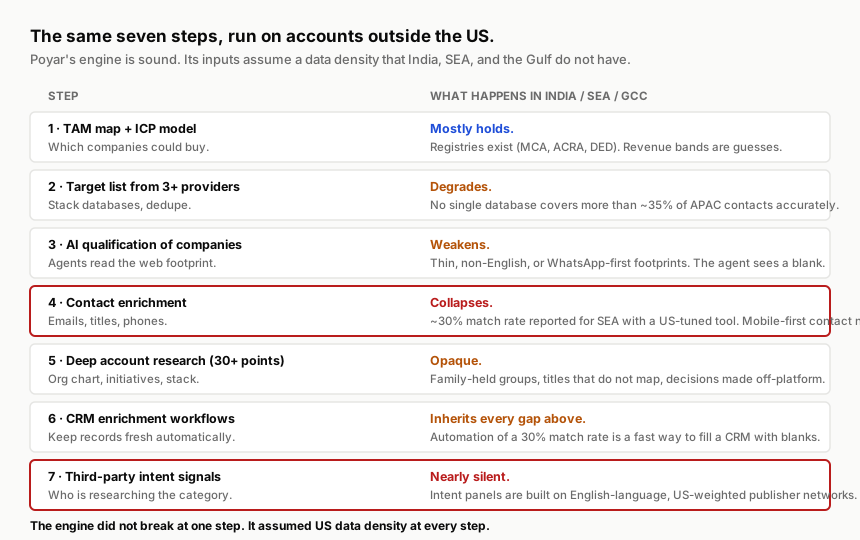
Walk the seven steps with that in mind. TAM mapping mostly holds, because company registries exist everywhere: India’s MCA filings, Singapore’s ACRA, Dubai’s DED licensing. List building degrades as the providers thin out. AI qualification weakens because the agent is reading a web footprint that, for a mid-market Indonesian distributor or a family-held Saudi group, barely exists in a form it can parse. Contact enrichment is where the engine visibly collapses: that 30 percent match rate, on accounts where the decision-maker’s working contact is a mobile number on WhatsApp, not a corporate inbox. Deep account research runs into org charts that do not map to Western titles and decisions made in rooms with no digital trace. CRM enrichment workflows then automate every one of those gaps into the system of record. And third-party intent, the step that makes US ABM feel like magic, goes nearly silent, because intent panels are built on English-language, US-weighted publisher networks that these buyers rarely visit.
Nothing on that list is a tooling failure. It is the same engine, starved.
Teams outside the US copy the blueprint, hit the wall in the first week, and conclude they built it wrong. They built it right. They fed it inputs it was never designed for.
The scarce input is not data
Here is the reframe that took me too many years and too many vendor evaluations to reach. In the US, the scarce input to ABM is data, so the engine is a data-acquisition machine: buy, stack, enrich, score. Outside the US you cannot buy your way to the same density, which the Bitscale regional guide concedes in its own way by telling teams to test regional match rates on their own ICP rather than trust published coverage. Once you accept that, the scarce input changes. It is not data. It is signal: a reliable indication that a specific account is in motion. And signal, unlike data, can be designed.
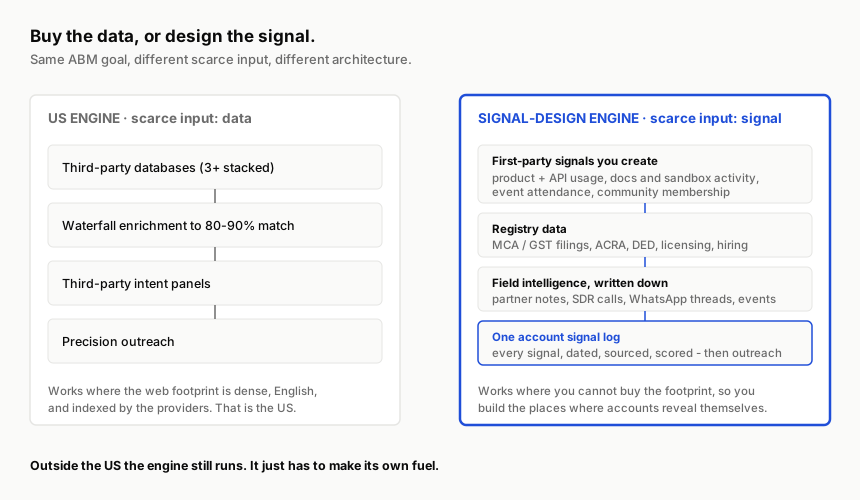
Three signal sources replace the third-party stack, and each requires building something rather than buying something.
First-party signals you create. Product and API usage, sandbox and documentation activity, event attendance, community membership. Every one of these is an account telling you it is in motion, in a form no provider has to index. In a developer-adjacent category this is the richest intent data in existence, and it is yours. The marketing job becomes building the surfaces that generate it: the sandbox worth trying, the community worth joining, the regional event worth attending. I wrote about agents becoming the first evaluators of vendors; the same machine-readable surfaces that serve agents double as first-party signal collectors.
Registry data. Filings, licenses, hiring. India’s MCA and GST data tell you more about a company’s real size and trajectory than any revenue estimate from a Western database, and regional providers now package them. This is the one place where “buy more data” still applies, as long as it is the local data.
Field intelligence, written down. The partner who mentions an account is replatforming. The SDR call where a buyer says the budget cycle starts in April. The WhatsApp thread with a reseller. In thin-data markets this is where most of the real intent lives, and most teams let it evaporate in chat apps and memories. The discipline is one account signal log: every signal dated, sourced, and scored, the same way I argued a team should keep one shared context file instead of five private ones. The log is the intent panel. You just have to write it.
What this changes in the plan
Three operating consequences follow for anyone running ABM outside the US, or running a global program from a US headquarters that wonders why the APAC numbers look broken.
Budget the signal, not the data. The $2,000-per-TAM-map line in a US plan becomes event, community, sandbox, and partner-enablement spend in an India or GCC plan. Same intent, different ledger line, and the finance conversation needs that translation up front or the regional plan looks like it is refusing to buy tools.
Score accounts on signal recency, not firmographic completeness. A US engine scores accounts on how much it knows. A signal engine scores them on how recently they moved. An account with a thin profile and a sandbox login this week outranks a fully enriched account with no motion in a quarter.
Treat the regional team as the data provider. If field intelligence is the intent panel, the people collecting it are infrastructure. That means making the signal log the easiest thing in their day to update, and treating a reseller who shares account notes as a data partner, because that is what they are.
Poyar’s engine is a genuine advance, and I would build it exactly as described for a US target list. The mistake is believing its architecture is universal when its fuel supply is not. Outside the US the engine still runs. It just has to make its own fuel, and the teams that understand that will stop blaming the engine and start designing the signal.