Zero-click hit 68%. Chasing AI citations harder is the wrong response.
8 min read
TL;DR: Google reports stable clicks and record queries. Clickstream panels report 68% of US searches ending without a click. Both are true at once: queries grow, the share that reaches any website shrinks, and the clicks that survive are the ones where the searcher already knew the name. The durable response is branded demand, not more answer-engine content.
The slide is already in your deck. Organic sessions, down for the third quarter running, with a note in the speaker text that says “AI Overviews.” Someone on the leadership call will have read that Google says the opposite: clicks to websites are stable, queries are at an all-time high. You will be asked which is true. This essay is the answer I would give in that room, with the documents.
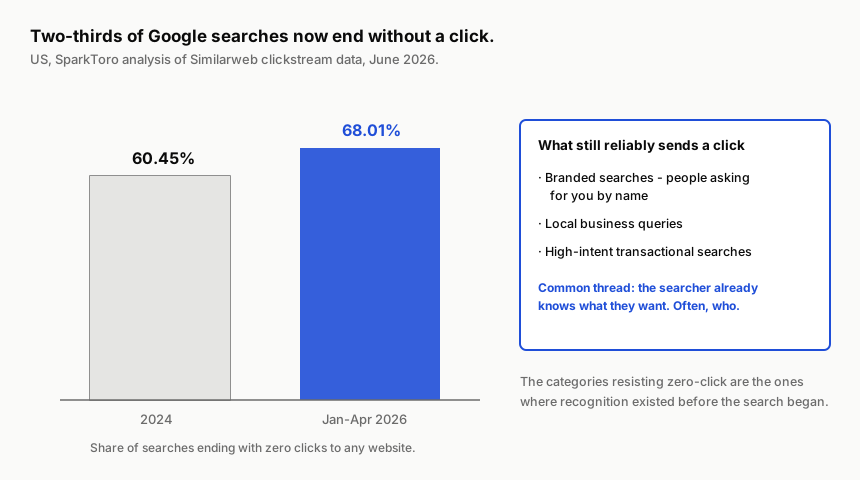
The number that started the argument is SparkToro’s 68.01%: the share of US Google searches that ended without a click to any website in January through April 2026, measured on Similarweb’s desktop and mobile web clickstream panel, up from 60.45% in 2024 on the same panel. The number that answers it is Google’s own, from Liz Reid, the head of Search, in August 2025: “total organic click volume from Google Search to websites has been relatively stable year-over-year,” with “slightly more quality clicks” than a year earlier, where a quality click is one where “users don’t quickly click back.” Reid dismisses third-party decline reports as “flawed methodologies, isolated examples, or traffic changes that occurred prior to the roll out of AI features.” She publishes no numbers.
Two ledgers, both honest
The two claims measure different things, and the gap between them is the whole story.
SparkToro measures a share: of all searches, what fraction produced a click to any site. Google measures a volume: the total clicks it sends out. If the number of searches grows faster than the share of clicking searches falls, total clicks can hold flat while the share collapses. That is exactly what Google’s own filings describe. On the Q1 2026 earnings call Sundar Pichai said “queries are at an all time high.” On the Q2 2026 call on July 22 he said AI Mode had passed a billion monthly users, that “just like AI Overviews, AI Mode is driving an incremental increase in Search queries overall,” and that Google is “sending billions of clicks to websites every week through AI features in Search.” Search and Other revenue grew 17% to $63.3 billion that quarter, the CFO confirmed, “primarily driven by Search.”
Walk it with made-up round numbers to see the shape; the only real anchors are the two share figures. Take 100 searches in 2024 with a 60% zero-click rate: 40 clicks leave Google. Now let queries grow 20% to 120 in 2026, with the zero-click rate at 68%: 32% of 120 is 38 clicks. Volume “relatively stable,” down 5%. Share of searches that ever reach a website, down from 40 to 32 out of every 100, a fifth gone. Both ledgers are honest. Only one of them is about you, because your site does not receive Google’s total. It receives a slice of a shrinking share, and the slice is moving.
The cleanest public casualty
Google will not publish absolute clicks by site. Most companies will not either. One large publisher does, every hour, through a public API: Wikipedia. English Wikipedia is the most-cited reference on the web and one of the most-summarized by AI answers, so if a zero-click shift is real, it should show up there before almost anywhere. I pulled the monthly human pageviews from the Wikimedia pageviews API for January 2022 through September 2026 and charted them.
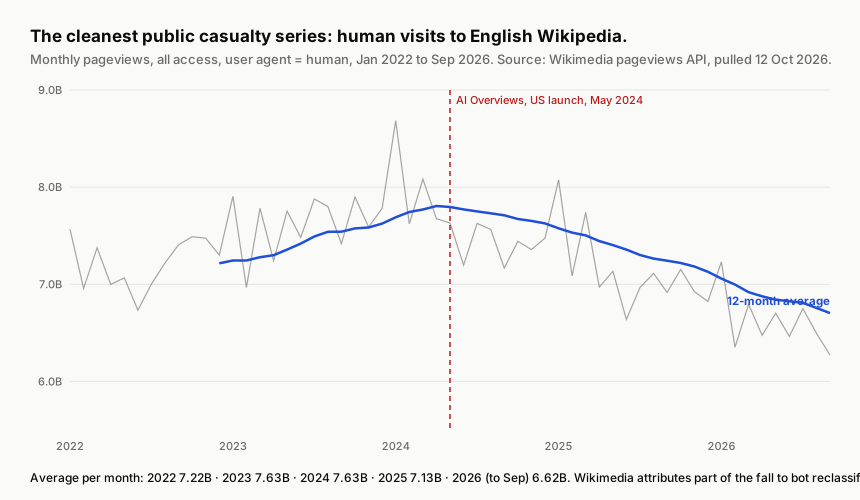
The averages per month: 7.63 billion in 2023, 7.63 billion in 2024, 7.13 billion in 2025, and 6.62 billion across the first nine months of 2026. Against 2024, that is 13% lower. The Wikimedia Foundation’s own October 2025 analysis by Marshall Miller put the human decline at “roughly 8%” against the same months of 2024 and gave two causes, which matter for reading the chart honestly: a reclassification of traffic that turned out to be bots “built to evade detection,” and “the impact of generative AI and social media on how people seek information, especially with search engines providing answers directly.” Some of the drop is measurement. The rest is the mechanism in the previous section, happening to the site that least deserves it.
Google measures the clicks it sends out. You receive a slice of a shrinking share, and the slice is moving toward the searches where people already knew the name.
What the engines take, and what they send back
The reflex response to all this is to feed the engines harder: more answer-optimized content, more citation chasing, a budget line for AI-visibility tooling. Before approving that line, look at the exchange rate the engines actually offer. Cloudflare, which sits in front of roughly a fifth of the web, published its crawl-to-refer ratios on August 29, 2025: “how many pages a platform crawls compared with how often it drives users to a website.” For July 2025, on Cloudflare’s network: Google 5.4 pages crawled per visitor referred, Microsoft 40.7, Perplexity 194, OpenAI 1,091, Anthropic 38,065. And the purpose of all that crawling, per the same post: “80% of AI crawling was for training, compared with 18% for search and just 2% for user actions.”
Read those two facts together. Classic search runs at roughly five pages read per visitor sent, a trade that built the open web. The AI-native platforms run at hundreds to tens of thousands to one, and four-fifths of their reading is not to answer anyone’s question today; it is to train a model that will answer tomorrow’s without visiting you. Content volume aimed at the engines is a bid for the “18% for search” slice of a machine that mostly consumes. Kevin Indig’s Growth Memo tracking caught the same thing from the other side in June: Reddit, Facebook and Instagram, the largest content archives in existence, all gained search visibility over four weeks while losing AI Overview mentions. If their volume cannot buy citations, yours will not.
What survives, and why it is the same thing
Back to the share chart. The query categories that still reliably click, in SparkToro’s breakdown, are branded searches, local business searches, and high-intent transactional searches. Google’s own definition of the clicks it is proud of, the ones where “users don’t quickly click back,” describes the same population from the other direction: a searcher who arrived meaning to arrive. Both ledgers agree on who still clicks. It is the person who typed your name.
That is the asset the zero-click shift cannot touch, and it is the same input the engines use. When a buyer asks an answer engine what to use for a category, the engine assembles its shortlist from names that already recur across the sources it trusts. When that buyer skips the open question and asks about you directly, no algorithm rotation intervenes. Recognition earns the citation and earns the click. Content volume rents one of those, briefly, at 1,091 to 1.
The one-hour gut check
Before moving money on any of this, pull twelve months of Search Console and answer two questions. What share of your clicks come from branded queries? Is that share rising? I wrote about instrumenting AI referrals cheaply before buying tooling; this is the cheaper sibling, and it tells you which ledger you live in.
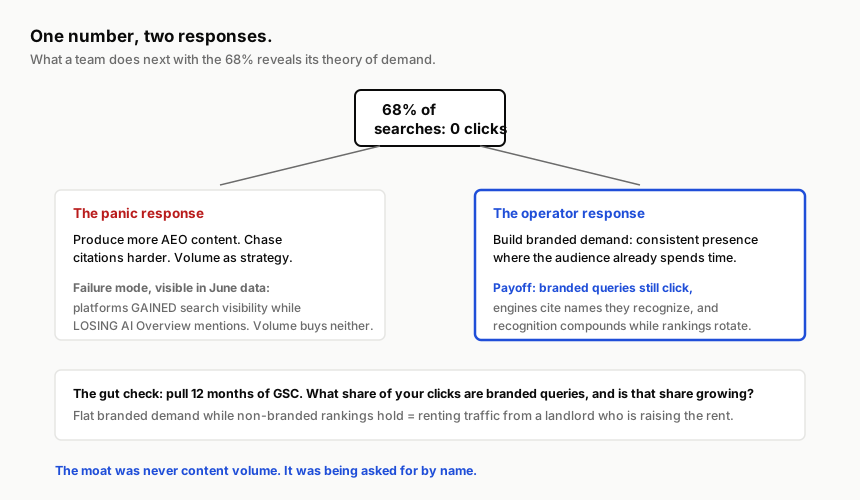
If branded demand is flat while non-branded rankings hold, you are renting traffic from a landlord raising the rent, and the AI-content plan is a bid to rent from a second landlord at a worse rate. If branded demand is growing, the zero-click number is mostly someone else’s crisis. Answer-engine hygiene still matters: clean structure, extractable answers, crawlable pages, an llms.txt. This site does all of it, and it costs days. The argument is about the marginal dollar after that, which goes to the podcast circuit, the communities, the consistent named point of view, the things that make someone type the name.
What I do not know
Google does not publish absolute click volumes by site or in total, so “relatively stable” cannot be checked, and the worked example above is illustrative, not measured. The clickstream panel behind the 68% covers desktop and mobile web and excludes the Google app, which is where a growing share of mobile searching happens; the real share could be higher or lower. The Wikipedia decline mixes a real behavioral shift with a bot reclassification the Foundation itself flagged, and I cannot separate the two from the public series. Cloudflare’s ratios describe Cloudflare’s network, not the web. And none of these sources isolates B2B searches, where the zero-click rate for long, specific, commercial queries may look nothing like the average.
What to watch from here
- Alphabet’s Q3 2026 earnings call, late October. Listen for any absolute figure to replace “billions of clicks every week.” A number would end this argument; its continued absence is also information.
- SparkToro’s next clickstream study. Same panel, next window. If the share passes 70%, the mechanism in this essay is accelerating; if it stalls, AI Mode’s growth is coming from new queries rather than replaced clicks.
- Cloudflare’s quarterly crawl-to-refer update. The ratios moved sharply inside 2025. If OpenAI and Perplexity keep improving, the “feed the engines” bet gets cheaper, and this essay gets weaker.
- The Wikipedia series itself. The API link above is public. Check it in January: if the 2026 average finishes below 6.5 billion with bot reclassification already behind it, the behavioral shift is confirmed.
Zero-click is real, rising, and mostly a tax on being generic. The moat was never content volume. It was being asked for by name, and both ledgers, Google’s and the panel’s, say so.